Showing posts with label Evangelism. Show all posts

Wednesday, September 14, 2011

Present in fair and flood


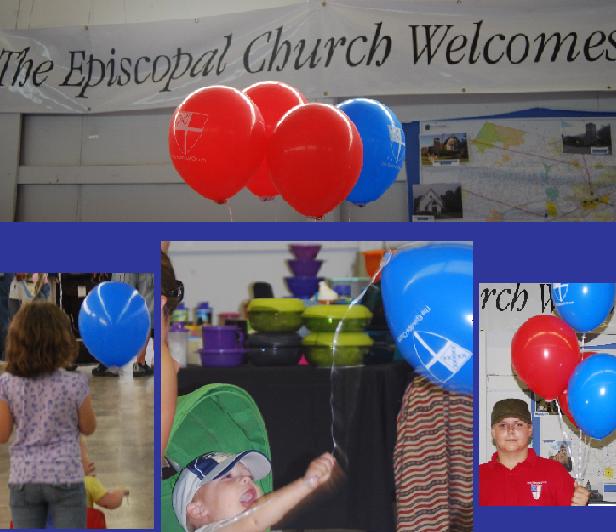
As the flood waters ravaged Luzerne County and other parts of northeastern Pennsylvania, the County Fair went on as planned. The Episcopal Churches of the Luzerne County, which still ministering to people in the flooded areas and contending with the possible threats against their own churches, still maintained their planned presence at the Fair.

Here is the account written by Janine Ungvarsky of Trinity, West Pittston and Co-Chair of 2011 Project Presence:
In the spirit of our diocesan mission to “tell what you have seen and heard,” I’d like to share some of the things seen and heard as the Luzerne County Episcopal Churches joined forces once again for Project: Presence at the 2011 Luzerne County Fair.

The fair opened Wednesday with pounding rain that kept away the crowds and sent us all home early. Thursday was even worse as flooding threatened a large section of the county and closed the fair. I didn’t have much hope for Project: Presence as I evacuated my West Pittston apartment Thursday afternoon at 1:30, with the Susquehanna River already swollen to within two blocks of Trinity.

I have to admit I was surprised when I checked the fair web site that evening and learned the fair was going to be opened on Friday “in response to numerous requests.” This made some sense, considering that the fairgrounds are located in an area not subject to river flooding and easily accessible via the Cross Valley Expressway for many of the other areas where evacuees sought higher ground. Though I had doubts about the turnout, I decided I would open the booth and invite volunteers who could safely do so to join me.

That first evening, I was handing a helium balloon to a little boy when I noticed a tear in his mother’s eye. The little guy was laughing big belly laughs as the balloon bobbed over his head in response to every move of his hand, and his mom said she was just so happy to see him relaxed and not crying or fussing for the first time all day. She confided that they were forced to evacuate their home in Harding, one of the areas hit hard by the flooding, and were staying in a relative’s home crowded with other family members also fleeing the flood. This young mother said she needed to get her rambunctious toddler out of the cramped quarters and to think about something besides what the flood was doing to her home. She talked and I listened, until her son decided he needed to be on the move again, and I couldn’t help but smile when I saw that mom and child were both giggling over the way the balloon bounced off her shoulder as they headed away.

Versions of that woman’s situation were repeated over and over again as people who hoped the levee would hold and those who already knew their homes had been devastated visited our booth.

There was the woman whose family was forced to evacuate their Kingston home. She brought her two tween-aged kids to the fair to stave off worry about her husband and older son, who went to West Pittston to help friends and were trapped on the home’s second floor by flood waters. She knew they were safe but said, “We just can’t sit in the house watching the endless flood coverage and worrying anymore.” Then there was the man who said he decided to come and watch some of the fair’s live entertainment while he waited for the evacuation order to be lifted because he knew gutting and repairing his flooded home would take up most of his free time for months to come.

Some of the most interesting moments came as people were talking to those of us from Trinity wearing red polo shirts embroidered with the Episcopal shield and the words “Trinity Episcopal Church West Pittston.” Many read the shirts and were surprised that we were there. “You’re from West Pittston,” one woman said on Friday at the height of the flooding, “And you’re here to talk to us and give all this stuff away? I’d be too worried to think about anyone else if it was me.” Others made similar comments, providing wonderful opportunities for us to share the reason for our hope and bear witness to the strength to be found in a life of faith.

Yes, we gave out almost 1,000 balloons in three days—about twice the number given out over the five days of the 2010 fair—along with hundreds of “Jesus Loves Me” kazoos that raised a joyful noise throughout the fairgrounds. We handed out loads of candy and shared information on the services and outreaches at our parishes. But I think the most significant thing we did in that flood-shortened fair was to bring some small respite to those fairgoers wearied by fear and stress by being there with open hearts to listen, comfort and share a prayer.

Our goal was simple: to be a presence at the fair, to let people know that the Episcopal Church welcomes them and is there for them. It may seem strange to go forward with that goal in the midst of a natural disaster, especially one that hit so close to home for many of us, but what better way for us to make our point than to be there in the midst of sorrow, loss and fear, sharing our reason for hope? Thanks to the efforts of my co-chair, Matt Stretanski, as well as Father John and Sandy Major, Debra and Larry Kellerman, Shane and Annie Sonday and Charlie Warwick as well as all the volunteers from Prince of Peace, St. Stephen’s, Grace Kingston, St. Clement’s & St. Peter’s and Trinity who were able to make it to the fair, I believe we accomplished our goal. Please join me in praying that those that we touched with our presence will find the peace and joy that comes from spending time in the presence of our God.
Community presence is a powerful tool to communicate the Gospel. Their presence at the fair was a spiritual ark to people who needed signs of hope in a difficult and uncertain time. They remained faithful to presence and proclamation when no one would have blamed them for staying home. Their presence at the fair opened up opportunities for grace. These congregations demonstrated how Christ changes lives and God is tangibly present even in the midst of trouble.

Amazing what a balloon can do!

Tuesday, June 14, 2011

A "Welcome card" can facilitate invitation

Most people who enter a faith community for the first time and stay do so because another lay person invited them. Beverly Bammel, a missioner at St. Francis, College Station, Texas, in the Diocese of Texas, says "This only makes sense. How often do we ask a friend their advice about a movie, a book, a doctor, or any countless number of things? We turn to someone who has first sampled the services or goods, someone with first-hand experience. Often we don’t even need to know this other person very well, and we’ll follow their advice."

She offers a practical tool any church can use to help members invite others to come and worship.

In the narthex of St. Francis, College Station, we keep “Welcoming Cards.” We encourage parishioners to take a dozen or so to keep in their wallets or purses. And when one of those Holy-Spirit moments occur, they can offer an invitation to visit St. Francis. They can tell them of our two primary worship services – Sundays and Wednesdays, and tell them how much they’d like it if they saw them again – at St. Francis! That’s all you need to do. Just invite them and give them a Welcoming Card.

I realize this can be scary. Many of us may not be comfortable in this type of situation. No worries. Just keep your Welcoming Cards stashed away. Don’t try and force yourself to begin passing out Welcoming Cards to everyone you meet. Wait for one of those Holy Spirit moments when your conversation “goes there” and suddenly you have a natural and comfortable opportunity to make the invitation. When that happens, make the invitation and give them a Welcoming Card. It’s that simple.

She notes that Bishop Andrew Doyle keeps cards for churches around his diocese.

Read the rest here.

Wednesday, January 26, 2011

Oprah meets Dr. Phill meets Bishop Sheen

The Hollywood Reporter says that Fr. Alberto Cutie, aka "Father Oprah," is starting a weekday syndicated daytime talk show. It will show up in the New York City and Los Angeles markets on local Fox-owned stations, and maybe in other markets.

Father Alberto Cutie, a bestselling author of self-help books and radio talk show host as well as a former Roman Catholic priest, will join the ranks of gabbers and host a daily syndie strip devoted to life matters.

"It'll be everything from sex to salvation," Father Alberto told The Hollywood Reporter Tuesday in Miami during the NATPE TV trade show.

Hopefully it'll invite "greater dialog" with the audience, he added. Sorta Oprah meets Dr. Phil meets Bishop Sheen, the only other religious personnage who ever fronted a national TV show. (And that was in the 1950s!)

The show is being licensed by Debmar-Mercury and the first station group to step up for a launch test is Fox.

The show will preview on a number of as yet unspecified Fox stations this summer. The Fox test markets will include N.Y. and L.A., the country's top two markets. Other non-Fox outlets may be invited to join the test as well.

Jack Abernethy, CEO of the Fox TV station group, said there has been a crying need for an inspirational show for stations for many years. "Something not dogmatic or rigid but uplifting and helpful to viewers. Such things are big business in other media like book publishing and the radio but not on television," he pointed out.

Father Cutie is not new to this kind of of work. He developed a huge following on Telemundo and in syndication in Latin America when, as a Roman Catholic, and became known as "Father Oprah."

The fact that an Episcopal priest has snagged a syndicated television project like this for a mass market audience (in two languages, no less!) is a very big deal. If it passes the test markets--mainly to see how well Cutie is received among non-Hispanic viewers who did not know him when he was on Telemundo--this will be a huge entry for the Episcopal Church in an audience that we do not often reach out to, in a forum that is new to us.

See also The Episcopal Cafe on this story.

Sunday, December 12, 2010

Tuning up your parish's web presence before Christmas Eve

The launch in mid-October of Vital Practices has yielded plenty of usable ideas. Case in point: a brief consideration of how parish web sites can welcome visitors on Christmas Eve with greater hospitality and more usable information.

Points:

  • ... Review your web page, voice mail, banners and signage through the eyes of someone visiting your parish for the first time.
  • ... Take a page from NPR’s digital media developers and go to a coffee shop, laptop in tow, and buy coffee for a stranger who is willing to poke around your website. Does their impression of your parish match up to your own sense of what the parish is?
  • ... Select your parish’s top stories from the past year and feature these on the homepage. These provide wonderful insight for potential visitors into the nature and values of the community they will be visiting on Christmas.
  • ... List your Christmas service times and include photos from last year’s service. If you don’t have any, make sure to ask someone to photograph this year’s event and save these photos for next year’s outreach.
  • ... Include the service times for the major feast days that take place from Christmas through Epiphany. These are great opportunities for folks to return.
  • ... Commit to a longer term review of your parish’s hospitality, perhaps by following some of Kathy Copas’ insights in this article.
Read the rest here.

H/T to Torey Lightcap writing on The Lead at the Episcopal Cafe.


Thursday, December 2, 2010

This is why Jesus quotes the BCP!

That's because Jesus was an Episcopalian.

Well, okay, maybe he wasn't...but maybe we secretly suspected!

Here is a sixteen-part video series introducing the Episcopal Church. It is based on the book by the Rev. Christopher Yaw. Here is what he says about the videos.
The point of this audaciously anachronistic title is not to claim Jesus as our own (how very un-Episcopalian that would be!), but to inspire us to see how Jesus is found in the many and varied expressions of faith that two thousand years of Christendom has birthed.

One such expression is the Anglican tradition in America, better known as The Episcopal Church. We are known more for substance than self-promotion - evenhandedness than extremism. Too often we are not easily noticed, found, or understood, which is why I wrote this provocative sounding book and companion website.

Today is an exciting time to be an Episcopalian. We have a renewed commitment to feeding the hungry and clothing the naked - standing up for equal rights and radical hospitality - worshiping in the beauty of holiness and making disciples who take Christ into the world.

Despite the polarizing forces at work in this age of transition, we are solidly emerging as a distinctive and dynamic alternative for many Christians. My hope is that these 16 video teachings can help newcomers and inquirers get a better sense of how The Episcopal Church endeavors to do Jesus' work in the world, to the praise and glory of His name.


Here are the rest of the videos and here is the book, Jesus Was an Episcopalian and You Can Be One Too.

Wednesday, December 1, 2010

Put the "mass" back in Christmas

Another nice, locally-made video from the folks at King of Peace Episcopal Church, King Island, Georgia.

Friday, October 1, 2010

Tailgate Eucharist

The Rev. Canon Dan Webster, canon for evangelism and ministry development in the Diocese of Maryland, talks about his experience of setting up a Eucharist for football fans in the parking lot of the Baltimore Raven before a home game.
It had been sometime since I had visited a parking lot before a National Football League game. In my previous career, and even during seminary, I followed television camera crews into special parking lots and flashed press passes at the media gates. So I guess you could say I had never "tailgated" at a Charger game in my hometown of San Diego or, for that matter, anywhere else.

I saw something called a Ravenswalk at Baltimore's M&T Bank Stadium, filled with bands, merchants, contests, games, food and fans. Lots of fans. It was the Baltimore Ravens' home opener and we at the Diocese of Maryland thought we should offer Holy Eucharist in the parking lot for Episcopalians who have to choose between church or football on the handful of Sundays the Ravens are in town.

One of our parishes had done this three seasons ago. The rector then, the Rev. Scott Slater, is now the canon to the ordinary. He encouraged us as we had plans in the works when he joined the staff this summer. It was actually our communications director, Sharon Tillman, who was the catalyst behind this. Not surprisingly she and her family are Ravens fans.

So we looked for an Episcopalian who has season parking passes in a lot near the stadium. We actually found Liz Diffenderfer from the Cathedral of the Incarnation. She has season tickets and knows folks in the Ravens front office. She tried to find us a location that would be semi-permanent so we could tell folks where we would be each Sunday where we might set up a portable tent and table to distribute tracts about the Episcopal Church.

That didn't work. We settled for whatever parking space Liz could find in Lot C just north of the main entrance to the stadium. We set up a portable table that Liz brought underneath her van's hatchback to protect against the rain. Sharon invited those around us to join if they wished. It reminded me of the parable of the kingdom in Matthew (22:2-10). "Go therefore into the main streets, and invite everyone you find to the wedding banquet." (22:9)

It was the 18th Sunday after Pentecost and the gospel reading (Luke 16:19-31) was about the rich man and Lazarus. The reading brought a chuckle when the rich man was described as "dressed in purple and fine linen." The Ravens' predominant color is purple. But it also was an opportunity to discuss being aware of the invisible people in our lives.

We weren't the only religious folks there that day. A local Chabad House of Lubavitcher Jews was celebrating Sukkot, the Feast of Booths. They had rented a pickup truck and built a sukkah in the truck bed. They asked people at random if they were Jewish and if so then invited them into the sukkah to pray.

Our prayers follow the form on pages 400-401 of The Book of Common Prayer. It is similar to a Eucharist you might experience at an Episcopal camp but without the music. There was plenty of music coming from the stage at the Ravenswalk. Some of that music seemed to be particularly meaningful to those faithful gathered in the rain to break bread and pray before kickoff.

We can now tell our congregations where we will be on Sunday mornings when the Ravens are at home so their parishioners may join us. We can also have brochures available for those curious about who we are and what we are doing. By our example we might attract some who have never been to church and don't know why it's important.

The medieval cathedral was the gathering place of the community. It was the focus of art, music, dance and debate. It was clear to me on that Sunday after Pentecost that many in our culture see the football stadium as a modern cathedral. We can let it be that way and leave it to its own liturgy or we can add our own. I prefer to "go into the main streets and invite everyone."
This makes me think: what with Sunday mornings becoming more and more the time when local sports, kids soccer, school sports take place, what if more of us set up "tailgate Eucharists" in the places where people gather? Thoughts?

Tuesday, August 31, 2010

Praying for growth in the Episcopal Church

Duke Divinity's blog Call & Response has this from Bishop of Georgia, Scott Behase:

While on holiday this summer I found myself praying about the growth of our church. What initially prodded my prayers was looking at the website of the United Methodist Church’s North Alabama Conference. My old colleague from Durham, Will Willimon, is the Bishop there.

Bishop Willimon publishes weekly statistics on things like membership, attendance, outreach, and the giving of each of the conference’s churches. It’s all there for everyone to see. As one might guess, the conference clergy don’t universally love this. But regardless of how one feels about such reporting, growth in membership, attendance, outreach, and giving matter. A lot. Jesus unambiguously pronounces the Great Commission. We are in the disciple-making business. And if we are not making disciples, then we need to change something we are doing (or start doing something we are not doing) so we make disciples (see also here, here and here on this).

Here are some random reflections on this challenge:

  • My hunch is that most people in our congregations think growing would be just fine but actually give little energy to it. The energy is around the people who are already there and their formation in faith. That’s energy well-spent. But we need to free up more people in our congregations to focus on making new disciples.
  • As a church we Episcopalians have been involved in some international and inner-church conflicts. This has taken a lot of time and sapped our energy for making disciples. This has to change. I don’t believe that our international church issues are a valid excuse for our lack of growth. There are a fair number of Episcopal churches that are growing, so there is no legitimate reason why each of ours can’t as well.
  • For too long we have looked to non-Episcopal, mega-church models to tell us how to grow. That hasn’t worked because it does not fit our identity and potential new disciples can sense the lack of congruency.

So what can we do? Let’s look at the congregations that are growing by making new disciples and see what they have in common. In these churches, growth is a by-product of manifesting their mission in a way that is consistent with their identity. They have a clear, shared understanding of their mission. They are not growing because they focus on growth as such, or because they will die if they don't get more people pledging their money (people are too savvy to want to join a church to share in its debt). They grow because they are clearly and unapologetically engaged in mission.

Growth in membership, attendance, outreach, and giving then are important metrics to see how we are doing at manifesting our mission consistent with our identity. They can never be the goals in and of themselves. Get mission going (not just be “mission-minded”), focus on making disciples, and then the growth will come.

Scott Benhase is the bishop of the Episcopal Diocese of Georgia.

Sunday, June 27, 2010

St. Simon the Cyrenian goes knocking on doors

Members of The Church of St. Simon the Cyrenian in New Rochelle, New York, spread out into the local neighborhood, ringing doorbells and invited people to church. Interim Pastor, the Rev. Canon Titus Presler describes on his blog how it came about and what happened on their first outing:

On Tuesday, June 22, four members of the Evangelism Team of the Church of St. Simon the Cyrenian visited about 70 homes in the immediate neighborhood of the parish in the first installment of what is planned to be a regular door-to-door outreach.

Such outreach is not exactly common among Episcopal parishes, so people often ask, “Well, what do you say when you go door-to-door?” Each pair of visitors asked residents this particular question, “Is there something you would like us to pray for in church at St. Simon’s this Sunday?” People were home at about 20 of the residences. Seventeen prayer requests were received, and these will be offered up in this coming Sunday’s liturgy. Each of the responsive households will receive a follow-up letter from the parish.

Team members went with an invitational card, and with a copy of the previous week’s bulletin. These were given to respondents and left in the mailboxes of those not home. The visitors were three members of the parish’s Men’s Fellowship – Ardon Michaels, Herman Harvey, Cuthbert Barker – and myself as the interim pastor. We split into two pairs and moved down on opposites sides of each street, ringing doorbells as we went. Team members plan to share from their experience during this Sunday’s announcements.

In only several instances were those who answered the door unwelcoming. Responses from others ranged from mild interest to real appreciation to theological discussion. Among the highlights:

• One person came out of her home and sat on the front stoop to engage a team with lengthy and cordial conversation.

• One person said he was a Muslim and therefore not particularly interested in conversation, but he thanked us for visiting and referred us to two apartments upstairs that we might otherwise have missed.

• Several people expressed appreciation that we were going door to door and noted that they were not used to seeing that. One person said that she had never seen a pastor visiting the houses on her street and that she was reassured by the sight.

• Of the 17 responding households, probably about a dozen already had a church that they regularly attended. We told them that we rejoiced in that. We certainly were not urging any changes in membership. With other households we were quite frank in inviting them to visit St. Simon’s.

• People had prayer requests You that they wanted to share. Some of them were very general like “world peace” or “family.” Other prayer requests were a good deal more specific.

• We were struck by how far many people travel to go to church. New Rochelle is a city of about 75,000 people located northeast of New York City, about a half hour away by train. Some respondents traveled to the Bronx, Brooklyn, Bronxville or Times Square to get to church.

The team met on the previous Saturday for an orientation session that I conducted. The group took as its biblical foundation Jesus words to his disciples, “Follow me, and I will make you fish for people” (Mark 1:17). I defined mission as ministry in the dimension of difference, an understanding that I have been working on for some time and which is developed fairly fully in my forthcoming book, Going Global with God: Reconciling Mission in a World of Difference. I defined evangelism as telling our story in the light of God story.

The evangelistic outreach of visiting homes in the neighborhood was related to St. Simon’s mission statement, which highlights an aspiration that the parish be a beacon for the community. I noted that St. Simon’s has a strong internal community but that last winter’s Vestry retreats had raised the question whether the parish was effective in having an impact on the wider community of New Rochelle and the neighboring towns.

The open-ended question – “Is there something you would like us to pray for in church this Sunday?” – is designed to catalyze conversation that has both the vertical dimension of relationship with God and the horizontal dimension of community care. It is a question that seeks to serve. It does not pry into people’s theological persuasion, nor is it aimed at buttressing church membership.

Evangelism is one aspect of the broader mission that the parish is organizing and which includes outreach to local colleges and service to major communities of need in the local area. For instance, last week a group of leaders from the parish met with the assistant to the city manager of New Rochelle in order to seek assistance in discerning how a congregation like St. Simon’s can best serve the wider community.

There are some aspects of this project that are worth noting:
  • motivation--The basis of the project was grounded in the congregation's understanding of mission and their role in the community as a "beacon for the community." Note how the parish undertook mission projects which involved going to city and civic leaders and listening to how the parish might serve the community more and in projects of direct outreach.
  • listening--I was intrigued by the question asked by the visiting teams to people who answered their doors, "“Is there something you would like us to pray for in church at St. Simon’s this Sunday?” Clearly, the visitors are telling people about St. Simon's and certainly their hope is that some people would come to their church. But the content of their opening question asks what St. Simon's can do for the person, and it is framed in terms of what St. Simon's does best. It is also a question that requires the inquirer to stop and listen to whatever comes next. So to do this successfully, the visitors must be ready to accept whatever response they get and must go with an accepting attitude, rather than wanting to change a person's mind on the spot.
  • story--I think a project like this is consistent with the work we in the Diocese of Bethlehem has been doing around evangelism, not only because the congregation chose a pro-active approach, but mainly because the approach St. Simon's chose is grounded both in mission and in the spiritual vitality of the congregation. Previously, the parish took their Palm Sunday procession which had previously been restricted to the church and parking lot out into the streets of their city. Folks who take part in the effort, must be aware of their own spiritual story, but also have the maturity and confidence to listen first, pray when needed, and the confidence to accept gracefully whatever response comes along.
This project shows how evangelism is grounded in the mission and spiritual vitality of a congregation.

Thursday, February 18, 2010

Ash Wednesday at the rail station.

Updated. The Rev. Lane Hensley of the Church of the Transfiguration in Palos Park, Illinois came out in the early morning to the commuter rail station and distributed ashes to commuters on their way to work. Other congregations did the same at other Chicagoland commuter rail stations, and there was ecumenical effort in the business district of St. Louis.

Father Hensley said he wanted to bring the Gospel to where people actually live and work. More images and the rest of the story may be found at Episcopal Cafe here.

Thursday, December 24, 2009

I am a closet Christian

One of our assumptions among the members of the Evangelism Commission is that Christians will never reach full maturity in their faith, and never begin to experience the fullness of being a follower of Jesus, until they find a way to articulate their faith.

Ada Calhoun writes in on her blog as Slate.com about her journey to becoming Christian, and her journey to being able to admit that she is Christian.

She says "I am a closet Christian. At least, I was until now. Because in my circle, nothing is more embarrassing than being religious."

It was Sunday morning in my scruffy Brooklyn, N.Y., neighborhood, and I was wearing a dress. Walking to the subway, I ran into a friend heading home from yoga class. She wore sweats and carried her mat over her shoulder. "Where are you going so early all dressed up?" she asked, chuckling. "To church?" We shared a laugh at the absurdity of a liberal New Yorker heading off to worship.

The real joke? I totally was.

Inside the church, it's cool and quiet. I read the Collect of the day in the Book of Common Prayer, which urges us: "While we are placed among 
things that are passing away, to hold fast to those that shall
 endure." My recent layoff no longer seems like the end of the world. I take Communion and exchange the peace and listen to the sermon. As I'm walking back up the aisle, I feel reoriented and calmer, the indignities of the week shift into perspective.

These moments are not only sacred; they are secret. Outside, on the steps of the downtown Manhattan church, I think I see someone familiar coming down the sidewalk, and I bolt in the other direction.

Why am I so paranoid? I'm not cheating on my husband, committing crimes or doing drugs. But those are battles my cosmopolitan, progressive friends would understand. Many of them had to come out -- as gay, as alcoholics, as artists in places where art was not valued. To them, my situation is far more sinister: I am the bane of their youth, the boogeyman of their politics, the very thing they left their small towns to escape. I am a Christian.

No doubt Ada is not alone. Many of us are closet Christians. How do we "tell what we have seen and heard" if we lock ourselves away in closets?

Read the rest of her story here.

H/T to Episcopal Cafe.

Tuesday, December 15, 2009

Getting ready for Christmas visitors

Most congregations will have to dust off the back—or the front!—pews on Christmas Eve. Churches find that a lot of people show up for what is both a major feast of the church and a major cultural holiday. The Christmas story reminds us that God is revealed to strangers and welcomes the outsider. How we prepare for Christmas at the doors of the church is every bit as important as what we prepare in the chancel.

There are many reasons that people come to Christmas liturgies: some prefer to come to church at Christmas and Easter; others come as a kind of “family reunion” gathering as a family in the church they took part in when the kids were younger and before they went their separate ways. Some folks are coming because they remember another church. Of course, some are coming for deeper reasons that they may or may not be conscious of. The major Christmas liturgies are a time of welcome and it is a time when the church is both ministering to the core congregation and to the larger community.

Don’t forget to prepare for visitors as carefully as we prepare our music, our flowers and greens and our liturgies. It is tempting to think that these special liturgies are for “us” and so end up treating visitors as outside observers or, worse, as interlopers. If there is ever a time when our liturgy is both a celebration of the community faith and a spiritual ministry to the community, Christmas Eve is it!

Here are some more or less random suggestions for extending hospitality to everyone on Christmas Eve. These are lessons that can be applied any time.
  • Everyone is a participant. In both our spoken communications and our printed notices be careful not to reinforce notions of those who “belong” or who are "insiders" and those who “don’t belong,” “we haven’t seen in a long time” or as "outsiders." We all are the recipients of God's welcome of strangers to the manger. Any hint that someone is perceived as an outsider is the same as saying, "No room in the inn!"
  • Avoid asking people to identify themselves publicly as visitors. For every one person who likes that kind of attention, there are ten who do not.
  • Repeat after me: “Merry Christmas. We are glad to see you.” Full stop. Avoid inadvertently shaming a person who “only” comes to church on Christmas and Easter. If the person in question brings it up, just smile (or laugh) and repeat the above line. If the worshipper is a person who was once very active in church and is now much less so, appreciate their presence now.
  • Don't assume that anyone knows anything! We long-timers may crack wise about “Episcopal aerobics” (you know, ‘stand, sit, kneel…’) and take pride in the hand-eye coordination it takes to juggle a Prayer Book, Hymnal and Bulletin, but for everyone else it can be an intimidating. Newcomers to our tradition or people who have not been to church for a while can be self-conscious about proper 'church-etiquette'. This is a good time to print as much of the liturgy as you reasonably can in one place.
  • Celebrate the church's faith without apology or hesitation. The Christmas Eve liturgy is the great rehearsal of the incarnation. All those who come want to be part of a living community's drama of welcoming Jesus. In doing so, they hope to discover again — or for the first time — who God is and who Jesus is — "up close and personal." Don't try to play to the audience. This is a glorious night full of God's splendor, mystery, and presence. Sing, pray, rejoice in all the ways your community is able. Deep joy and genuine excitement are contagious and appealing. Skip anything that is phony or contrived.
  • Encourage church members to show hospitality through attentiveness and warmth to those taking seats near them — making sure each person has a hymnal, a service bulletin, enough room, or a friendly word of guidance about where to turn in the hymnal. It is also a good idea to remind long-timers that they can gently help newcomers by sharing a hymnal or prayer book. If you see someone fumbling through a book trying to finding a page, try gently offering to exchange your prayer book for theirs. Ushers and greeters are important, but what will make a lasting and loving impression is the demonstration of grace and caring by the people in the pews who share the journey.
  • Orient ushers and greeters and make sure they are “on duty” and “on station” throughout the whole liturgy. Everyone may focus on the celebrant, preacher and choir but the first person a newcomer or visitor interacts with in your church is the usher and greeter. They should be focused on welcoming a newcomer, orienting them to the church and helping answer any questions. They should know where the rest rooms are, where to hang coats, be ready to pass along an activity bag for children, and invite them to coffee hour or hospitality after the service. Nothing sends a message of “you don’t belong and I don’t care” when an usher is chatting with members with their back to the door or who disappear after the first hymn.
  • Be ready to help parents with children who are not regular church-goers feel comfortable. Many parents have unrealistic notions of how children "ought" to behave in church. Many parents assume that churches are intolerant of children and fear that any little peep will attract disapproval. Proving them wrong would a pleasant and welcome surprise. If your church has activity bags or special bulletins for young children--or maybe a group can create small "gift" bags to give to parents with things that help children stay both occupied and engaged during the liturgy--make sure your ushers and greeters offer them to the parents and children as they come in. Don't wait for them to ask! If you have a nursery or a play area, make sure it is staffed and that there is a way for parents to still take part in the service maybe with Christmas books, coloring, etc. Long-timer parents with kids can assist visiting parents and their kids by helping them relax and enjoy the service.
  • Update your newcomers materials and have them ready.
  • Be sure all know how they are to receive Holy Communion. A simply worded notice in the bulletin or a brief explanatory word just before people partake will be a generous act of hospitality.
  • Love all the people just because they are there for this time, this holy night. Forget about wondering and worrying about whether or not they will come back.
  • Do leave breadcrumbs along the path so that if people want to come again, they know how and when to return. The Christmas Eve bulletin can be a great vehicle to describe in a brief, attractive way the unique ministry of your congregation and communicate when you routinely worship, how to contact the church office or clergy. Have materials ready for people to take home about your parish. Bulletin notices or a special insert with worship times welcomes participation and sends the right signals.
H/T to Daniel Benedict of General Board of Discipleship of the United Methodist Church whose work on this topic was adapted for this post.

Saturday, November 28, 2009

Detoxifying the 'E' word

John Smith writes in the Reading Eagle about the Presiding Bishop, Katharine Jefferts Schori visited the Diocese of Bethlehem earlier this month.

One of the things our diocese did--which we found out after the fact was fairly unusual (good for us)--was that we spent the better part of four hours orienting her to our diocese. We shared with her the state of our diocese. We told her about what we do well and we were also honest about our greatest challenges. We shared both data and stories.

The Evangelism Commission shared our story, our process and our dreams as well as our accomplishments and our sometimes-successful-and-sometimes-not experiments. I thought that she engaged us the most when we began to talk about "effective communication of the Good News of Jesus Christ" to those outside the church. Bishop Katharine asked questions of us, wanted to know what worked, and was very interested to know about our work with Unbinding the Gospel. (Our gift to her was a copy of that book with a bookmark placed in Chapter Eight, which is where I think that every clergyperson should read first before going into the whole series.)

We were very cheered to hear talk about the things she learned about us when she preached and answered questions. She spoke of the joys and challenges of "telling what we have seen and heard" and we heard her talk directly about evangelism, putting it square into the context of mission. Her words and example went a long way towards "de-toxifying" the dreaded "E" word in the Diocese of Bethlehem.

For Episcopalians, de-toxifying the "E" word will mean doing more of what we are really good at--and communicating the 'why' behind what we do well--and less of trying to imitate what other traditions do a lot of. We can fall into our own version of toxic evangelism if we succumb to the temptation of believing that somehow the Gospel only resides in the Episcopal Church and everyone else is at least mildly deluded. What is important is that the way Episcopalians receive and live the Gospel does explicitly answer real human needs and points people to Christ. If the Gospel message brings life, then it is imperative that way we bring it be life-giving.

Here is what Mr. Smith wrote in the Reading Eagle:
The presiding bishop of the Episcopal Church has a few words she doesn't care for. Evangelism isn't one of them.

Bishop Katharine Jefferts Schori highlighted "the dangerous 'E' word" in her message to members of the Diocese of Bethlehem in Lebanon earlier this month, admitting the word is toxic to most Episcopalians....

...Jefferts Schori offered a five-point message, doubled. She ticked off five marks of mission the church has adopted: proclaim the good news; teach, baptize and nurture its members; relieve human suffering; change the unjust structures of society; care for the Earth.

She also offered five different ways to implement the marks: to grow congregations in their ability to practice mission; identify and evangelize the community; emphasize education and formation for all ages; battle poverty and injustice in intentional ways; develop networks, partnerships and covenant relationships.

Regarding evangelism, the bishop said she hoped Episcopalians would feel as comfortable sharing the good news about Jesus as about a new restaurant they had discovered. On education, she suggested they use their brains, not just their ears....

...Other words could be problems and concerns. During the well-received Q-and-A session that followed, I asked what she considered her biggest one.

"The biggest challenge," the bishop replied, emphasizing the noun, "is growth." She said the church is losing 19,000 members a year, partly because "Anglos don't produce children." The overseas dioceses are growing, but the only four doing so last year nationally were Navajoland, Wyoming, North Dakota and Alabama. (Discounting Alabama, one might assume the church appeals to cowboys and Indians.)

That led to further evangelism talk. She called the church an attractive faith tradition for those of a Catholic background who don't want someone telling them what to do or have to worry about excommunication. "But we can't wait for them to come to us," she said. "We must be out in the community, sharing."
Read the rest here.

Tuesday, October 20, 2009

Ideas that spread win

The Gospel spread like wildfire in the first few centuries of the church because...it was new...and because it was an idea that spread...and because it did not speak to the core of the society of the day but because it spoke the fringes that were truly interested.

Perhaps the Reformation spread the same way? How about the first and second Great Awakening? Methodism, too? How Christianity in Africa today? Maybe the times when Christianity spreads is not because it is simply a "good" idea, but an idea that spreads.

See this video:


How does the Gospel message once again become an "idea" that spreads among "people who are interested?" How do we once again communicate to the interested fringes that spread the message? Ideas that spread, win.

H/T to Bill Lewellis at DioBeth NewSpin.

Wednesday, August 12, 2009

Evangelism: The Boxed Set

Episcopal Cafe has posted a link to four lectures on Evangelism given in the Diocese of Washington. Here is what the Cafe says:
The presenters were Brian McLaren, Dean Ian Markham and Professor David Gortner of Virginia Theological Seminary and the Rev. Terry Martin, better known to some of you as Father Jake.

These are Windows Media files. We hope to have Quicktime available soon.


Maybe these will end up on YouTube, too? Just a thought. In the meantime, go here.

Friday, April 10, 2009

Passion play on twitter

Trinity Church, Wall Street today had a passion play entirely on Twitter.

Here is the text
:

twspassionplayvia @_Peter_of_: is waiting in the courtyard of the High Priest Caiaphas. I ran scared when the officers came but I need to see how this ends.
8 minutes ago from GroupTweet

twspassionplay via @ServingGirl: Darkness and earthquake. I heard the curtain in the temple was torn in two. I wonder�
less than a minute ago from GroupTweet

twspassionplay via @Pontius_Pilate: They want this done by nightfall. I sent my soldiers to break the dead men�s legs. Are my hands clean of this?
less than a minute ago from GroupTweet

twspassionplayvia @ServingGirl: is so tired. Caiaphas and the priests have been up all night questioning a man who claims to be the Messiah. And I wait on them.
8 minutes ago from GroupTweet

twspassionplayvia @_JesusChrist: Let the scriptures be fulfilled. It is as the prophets wrote. I am who you say I am.
1 minute ago from GroupTweet

twspassionplayvia @_Peter_of_: is heartsick. I abandoned him. I denied him. I couldn�t believe it, even as the words came out of my mouth.
about 1 hour ago from GroupTweet

twspassionplay via @Pontius_Pilate: Bad feeling about this. The prisoner won�t talk. The priests accuse him of blasphemy and sedition, and he just stands there, waiting
about 1 hour ago from GroupTweet

twspassionplay via @Mary_Mother_Of: I have no peace, though I have talked with angels, and in my bones I know he is Emmanuel. It rips me to hear the crowds chant �Crucify him!�
about 1 hour ago from GroupTweet

twspassionplay via @Pontius_Pilate: What harm has this man done? Why does the crowd cheer on his murder? I wash my hands of this. They can do what they want
about 1 hour ago from GroupTweet

twspassionplay via @_JesusChrist: Father forgive them, they know not what they do.
39 minutes ago from GroupTweet

twspassionplay via @ServingGirl: This crowd is rough. Talk of his blood on our hands�but if he is really the Messiah God will rescue him.
39 minutes ago from GroupTweet

twspassionplay via @_JesusChrist:It is as the prophets have written: I tell my tale of misery while they look on and gloat.
33 minutes ago from GroupTweet

twspassionplay via @Mary_Mother_Of: The light is going from the sky. I am alone here. Give me strength, God of the Universe.
39 minutes ago from GroupTweet

twspassionplayvia @_JesusChrist: Father into thy hands I commit my spirit.
25 minutes ago from GroupTweet

twspassionplay via @ServingGirl: Darkness and earthquake. I heard the curtain in the temple was torn in two. I wonder�
less than a minute ago from GroupTweet

twspassionplay via @Pontius_Pilate: They want this done by nightfall. I sent my soldiers to break the dead men�s legs. Are my hands clean of this?
less than a minute ago from GroupTweet

twspassionplay via @JosephArimathea: is sleepwalking through this. I cut the tomb, bought the linen, hold his body�and he�s gone.
2 minutes ago from GroupTweet

twspassionplay via @Mary_Mother_Of: I saw the water and the blood. I want to scream with him: Eli, Eli, lema sabachthani?
2 minutes ago from GroupTweet

twspassionplay via @Mary_Mother_Of: They sealed his tomb at dusk. The stone stands between us, and I can�t leave. I am an old woman now, lost in the dark.
less than a minute ago from GroupTweet

Claiming holy ground

One hundred people or so gathered in one place to worship in Liverpool. So what? Is this news? It was not what they did that is different but how they did it.


This gathering was called a 'flash mob,' a group of people who plan a "spontaneous" or improvised event where people don't expect middle of a shopping mall in Liverpool, England. Think of "improv everywhere" who did this version of a flash mob:


Bishop David Thomson, Bishop of Huntingdon (England) describes a "flash mob" for the rest of us on his blog "On Holy Ground:"
A flash mob, for oldies like me, is a large group of people who assemble suddenly in a public place, organized by texts or the like, and perform an unusual action for a brief time, then quickly disperse. Last Saturday the group dream - re-imagining worship brought together a group of mainly young people for an act of worship in Liverpool One Shopping Centre.
As described on the website "Dream: re-imagining church" here is what happened.
We began scattered among the shoppers. At the signal, we all stopped and took off our shoes ... an ancient sign that this is "holy ground". God lives in shopping malls as well as churches!
We then made out way to the park at the centre of the mall where we sat together to form a cross ... and prayed silently for a few minutes. We remembered Easter and the cross. We prayed for the current economic situation ... for those who have lost jobs ... and for God's blessing on our city ... we prayed for hope.
Ruth Gledhill writes:
This is thought to be the first time 'flash mob' has been used to generate a 'random' act of Christian worship. It took place last Saturday at Liverpool One Shopping Centre....

...Stuart Haynes from the Liverpool diocese told me more: 'It was the brain child of one of our Pioneer Ministers, Richard White, who has taken the idea from the flash mob events and tried to use it in a worship concept. The idea was planned via a Facebook site called Guerilla Worship. Richard led the discussion with a whole range of people bringing ideas together for what to do. They settled on an event at 4pm on the 4th April in the Liverpool One Shopping centre in the heart of the city. About a hundred participants came together - milled around in the centre – and then at a prearranged signal, the umbrella in the video took their shoes off and gathered in the parkland. The symbolism was to reclaim the area as Holy Ground – hence the removal of shoes. They prayed for the city, for the current crisis and released a balloon to symbolize the prayers going to God. The group wanted to create a talking point in the city and to catch the attention of passers by as well as creating the video which we now hope to go viral on the internet. It is experimental but was a success and the group plan more events in the future. The minister behind all this – Richard White – is an ordained Anglican minister working to create network church. The dream network aims to reach out into new communities and the online world.'

Over at Preludium, Mark Harris says:
I thought it was great. What's with taking off the shoes? What did people think? Etc.
And then he plays around with his own imagining of how flash evangelism might look.

The idea of gathering Christians in one place is not new. The idea of Evangelism is not new. Even the idea of praying in public is not so new. The innovative thing here is that is that public "spontaneous" act of worship in an unexpected place is an act that is designed to intrude or at least break up the rush and reactivity of daily life and call attention to the Gospel in a way that poses more questions and suggests, but does not force, answers.

It shows us how community, worship and evangelism can happen outside of the settings we have come to expect.

Saturday, March 7, 2009

What is Evangelism?

Let's start here. Evangelism is effective proclamation of the Good News of Jesus Christ to those who do not believe and to those who have not heard. This is a good place to start, but there is much more to evangelism than this.

We tend to confuse the call and gift of evangelism with the techniques associated with it. This for many our chief block to evangelism: confusing technique for content. We tend turn something more into something less.

Within Evangelism, there are a variety of techniques and methods. Their utility depends on the time, commitment and energy we have invested to do them well. But even as we work hard at doing these well, we must always be careful never to confuse the medium for actual evangelism.

We might spend a lot of time marketing our churches; that is, letting the community at large know we are there. While marketing is not evangelism, it can be a useful and effective tool for evangelism.

Hospitality is very important. Making our churches as genuinely welcoming as can be is vital to the vibrancy and sense of welcome of our congregations. This is at the heart of what many congregations can do to practically evangelize the people who come to the worship or programs of the Church. But hospitality is not evangelism, but an essential element of evangelism.

We have also spent time over the years on storytelling as at the heart of evangelism. To effectively tell the story of our faith, of how God has touched our lives and how we changed through our relationship with Jesus Christ under the power of the Holy Spirit, is at the core of what it means to be an evangelist. Even this, in an of itself, is not evangelism.

Evangelism is more than any of the techniques we might us. It is nothing less than the effective proclamation of the Good of Jesus Christ to those who do not believe and to those who have not heard. To effectively proclaim the Gospel of Jesus is also to trust the God will use the outcome for God’s purposes. The people we share the Good News with may respond, but maybe in a way that is different than we expect. They may join a church of another tradition. They may chose to become a "solo" or "lone" believer who does not attach to a single community. They may hear, understand, and even accept the validity of what we say. and still not choose to come to the waters of baptism. Our job is to bring the message and to give the results to God.

How do we know our evangelism is working? Each subset and tool of evangelism has their own measures of success: for example, the number of visitors might tell us how good our marketing campaign was. We might measure the quality of our hospitality through how many visitors returned and how many of them became inquirers. We might measure how many inquirers become baptized members and this will tell us how effective we are at incorporating new members into our congregations. But none of these, even taken together, tell the whole story of what effective evangelism is.

We know we are doing effective evangelism when we see more and more Christians showing and telling the Good News of God in Christ. When we become natural and effective communicators of the Gospel, then we know that evangelism is making a difference. When our evangelism transforms our living so that we do not compartmentalize our faith but instead sees every day, every relationship, and every encounter as being and seeing Christ, then we know that our evangelism is making a difference both in our lives and in the lives of others.

Evangelism is more than the sub-sets of communications, marketing, hospitality or even personal evangelism and storytelling, no matter how well we do it. Evangelism, at its heart, is sharing with others without strings or conditions the gift that we ourselves have been freely given: new life in Jesus Christ.

(Note: This is a reprint of an article written in April, 2007 and revised in April, 2008 for the Evangelism Commission of the Diocese of Bethlehem. It had previously appeared on the old web-page within the DioBeth website. Over the next few weeks, I will be migrating material from that site onto this blog. atg+)

Wednesday, March 4, 2009

Church shopping in America

Every year, around the start of the school year, it happens. Also around Christmas and Easter. Whenever a family moves to a new location or often after a family has changed, perhaps when kids move out or after a divorce or a death or a birth in the family, it also happens. Sometimes it happens just because Americans are consumers who like to shop.

What is it that happens? Americans comparison shop for churches. Most American can't imagine finding a church any other way. They like to visit, check it out the feel, taste the coffee, see the nursery, hear the music, meet the people, kick the tires. Church shopping is an American as apple pie.


Andrew Santella over at Salon looks at church-shopping, why we do and what congregations and clergy respond to the phenomenon:
Since before Election Day, Washington pastors have been lining up to invite the first family into their flock, and outlets from PBS to the Wall Street Journal have taken their turn handicapping the many contending congregations. Despite all of this cajoling, the White House announced that the Obama family is still shopping for a church in Washington.

Except for the special invitations and the presidential-scale press coverage, the Obamas' church search puts them in a situation a lot of American believers are well-acquainted with. One in seven adults changes churches each year, and another one in six attends a handful of churches on a rotating basis, according to the Barna Group, a marketing research firm that serves churches. Church shopping isn't a matter of merely changing congregations: Asurvey by the Pew Forum on Religious and Public Life last year indicated that 44 percent of American adults have left their first religious affiliation for another. "Constant movement characterizes the American religious marketplace," a survey summary said....

....Part of the discomfort with church shopping has to do with the way growing churches attempt to attract spiritual shoppers. That simple marquee in front of a church with the cheerfully homely motto ("Prevent truth decay: Brush up on your Bible") doesn't suffice to recruit worshippers. Web sites stream audio and video of sermons and music to let prospective members shop from home, and consultants help congregations market themselves to the "unchurched" and the merely unsatisfied by deploying focus groups, surveys, product giveaways (free church-branded Frisbees, anyone?), and other tactics borrowed from the commercial realm. The Wall Street Journal reported recently on churches employing mystery worshippers, "a new breed of church consultant," who covertly attend services and evaluate them (Were the bathrooms clean? Was the vibe friendly?) as if they were first-timers looking for a new church.
Diversity in the market place and the consumer habits of Americans can cause us to turn evangelism into mere salesmanship, and reducing religion to a low-demand-on-customer, lowest-common-denominator and even an entertainment driven experience might cause churches to grow but also create churches with huge turnover. Mega-churches know that 35-50% of their membership will turnover every year, so in order to maintain their large numbers, let alone grow, they must practice a kind of volume marketing.

The Rev. Shane Hipps, a former marketing executive and now Mennonite pastor, talked with Christiainity Today about consumerism, the church and why both mega-churches and emerging churches are here to stay. (Presumably that means that we traditional average- to small-sized congregations are also here to stay.)

In the "Dancing with Consumerism," Hipps says:
I make a distinction between three different kinds of consumerism. One is mainstream consumerism; the dominant hegemony that happens in our culture. Mainstream consumerism is mega. Walmart exemplifies this kind of consumerism, as does the mega-church. Boomer consumerism is mainstream consumerism.

Then you have counter consumerism, which is savviness. They are aware that Walmart and [Microsoft] Windows are trying to dominate, and they resist just like they resist mega-churches. But the odd thing is they’re no less consumers. They’re just counter consumers. A counter consumer buys Apple. It is absolutely consumer driven. They are consuming an identity that says we’re different; an alternative from the rest of you.
Santella says:
Church shopping, marketing, and the not-so-sanctified practices that go with them make easy targets for criticism. But competition among churches for worshippers has always been fierce in the United States, to the benefit of American religion and individual churchgoers. The prohibition against establishing an official state religion helped give us the shoppers' paradise that is our religious marketplace. Disestablishment (Massachusetts was the last state to cut ties to its official church, in 1833) meant that preachers had to learn to get along without support from the state. It made the ability to recruit and keep a flock—and get them to give generously—crucial to a church's survival.
We live in a culture driven by consumerism. Even in hard times we are trained to comparison shop, wiegh and filter various marketing appeals for all kinds of things, and we take for granted a certain level of hucksterism that shows everywhere from billboards to the logos on our clothes. In this environment, it is easy to choose to ignore the reality all together (and risk becoming invisible) or to forget that marketing is only a tool for evangelism on the one hand, and to remember that consumer values are what shapes the decision making of many church visitors.

Hospitality ministry, for example, brings both Gospel and cultural realities together: People are looking for a place of welcome and sense of being "at home" in a congregation. Jesus practiced radical hospitality. So can we. Offering a welcoming, inviting and listening church can bring Gospel witness to people in a way that is comprehensible to people who shop as a way of life.

Wednesday, February 25, 2009

I am Episcopalian

Check out these short videos of real people describing in their own words why they are Episcopalian.

Here is what the website says:

The Episcopal Church is a big, colorful, vibrant church. We hope you will see that in the wide spectrum of its members represented here on this site.

In our Church you may touch ancient traditions and experience intelligent inquiry. It is an expansive Church, a loving Church, with strong ties to our roots as a nation. We are a thoughtful, inquiring, freedom-loving and welcoming body, and we thrive not only in the U.S., but also throughout Latin America, Asia and Europe.

We invite you to see and hear the very personal reasons we choose to be Episcopalians. Our controversies and conversations have been public. Our governance is transparent. You are free to see our imperfections, as well as share our joy in that which unites us - our openness, honesty and faith.

We invite you to make your own 60-90 second video explaining why you are an Episcopalian and upload at the link here.