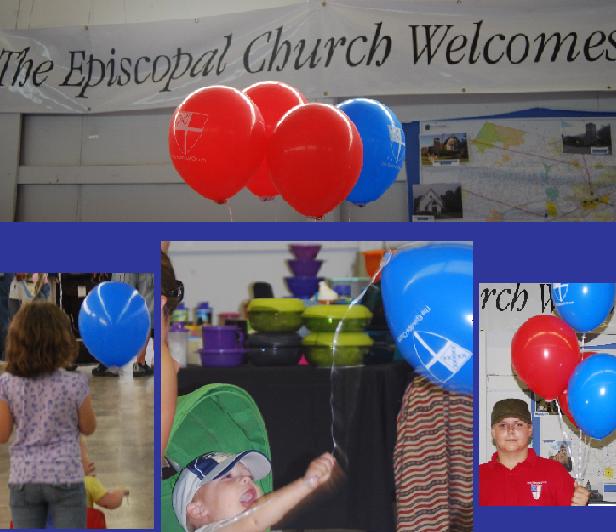
As the flood waters ravaged Luzerne County and other parts of northeastern Pennsylvania, the County Fair went on as planned. The Episcopal Churches of the Luzerne County, which still ministering to people in the flooded areas and contending with the possible threats against their own churches, still maintained their planned presence at the Fair.
Here is the account written by Janine Ungvarsky of Trinity, West Pittston and Co-Chair of 2011 Project Presence:
In the spirit of our diocesan mission to “tell what you have seen and heard,” I’d like to share some of the things seen and heard as the Luzerne County Episcopal Churches joined forces once again for Project: Presence at the 2011 Luzerne County Fair.Community presence is a powerful tool to communicate the Gospel. Their presence at the fair was a spiritual ark to people who needed signs of hope in a difficult and uncertain time. They remained faithful to presence and proclamation when no one would have blamed them for staying home. Their presence at the fair opened up opportunities for grace. These congregations demonstrated how Christ changes lives and God is tangibly present even in the midst of trouble.
The fair opened Wednesday with pounding rain that kept away the crowds and sent us all home early. Thursday was even worse as flooding threatened a large section of the county and closed the fair. I didn’t have much hope for Project: Presence as I evacuated my West Pittston apartment Thursday afternoon at 1:30, with the Susquehanna River already swollen to within two blocks of Trinity.
I have to admit I was surprised when I checked the fair web site that evening and learned the fair was going to be opened on Friday “in response to numerous requests.” This made some sense, considering that the fairgrounds are located in an area not subject to river flooding and easily accessible via the Cross Valley Expressway for many of the other areas where evacuees sought higher ground. Though I had doubts about the turnout, I decided I would open the booth and invite volunteers who could safely do so to join me.
That first evening, I was handing a helium balloon to a little boy when I noticed a tear in his mother’s eye. The little guy was laughing big belly laughs as the balloon bobbed over his head in response to every move of his hand, and his mom said she was just so happy to see him relaxed and not crying or fussing for the first time all day. She confided that they were forced to evacuate their home in Harding, one of the areas hit hard by the flooding, and were staying in a relative’s home crowded with other family members also fleeing the flood. This young mother said she needed to get her rambunctious toddler out of the cramped quarters and to think about something besides what the flood was doing to her home. She talked and I listened, until her son decided he needed to be on the move again, and I couldn’t help but smile when I saw that mom and child were both giggling over the way the balloon bounced off her shoulder as they headed away.
Versions of that woman’s situation were repeated over and over again as people who hoped the levee would hold and those who already knew their homes had been devastated visited our booth.
There was the woman whose family was forced to evacuate their Kingston home. She brought her two tween-aged kids to the fair to stave off worry about her husband and older son, who went to West Pittston to help friends and were trapped on the home’s second floor by flood waters. She knew they were safe but said, “We just can’t sit in the house watching the endless flood coverage and worrying anymore.” Then there was the man who said he decided to come and watch some of the fair’s live entertainment while he waited for the evacuation order to be lifted because he knew gutting and repairing his flooded home would take up most of his free time for months to come.
Some of the most interesting moments came as people were talking to those of us from Trinity wearing red polo shirts embroidered with the Episcopal shield and the words “Trinity Episcopal Church West Pittston.” Many read the shirts and were surprised that we were there. “You’re from West Pittston,” one woman said on Friday at the height of the flooding, “And you’re here to talk to us and give all this stuff away? I’d be too worried to think about anyone else if it was me.” Others made similar comments, providing wonderful opportunities for us to share the reason for our hope and bear witness to the strength to be found in a life of faith.
Yes, we gave out almost 1,000 balloons in three days—about twice the number given out over the five days of the 2010 fair—along with hundreds of “Jesus Loves Me” kazoos that raised a joyful noise throughout the fairgrounds. We handed out loads of candy and shared information on the services and outreaches at our parishes. But I think the most significant thing we did in that flood-shortened fair was to bring some small respite to those fairgoers wearied by fear and stress by being there with open hearts to listen, comfort and share a prayer.
Our goal was simple: to be a presence at the fair, to let people know that the Episcopal Church welcomes them and is there for them. It may seem strange to go forward with that goal in the midst of a natural disaster, especially one that hit so close to home for many of us, but what better way for us to make our point than to be there in the midst of sorrow, loss and fear, sharing our reason for hope? Thanks to the efforts of my co-chair, Matt Stretanski, as well as Father John and Sandy Major, Debra and Larry Kellerman, Shane and Annie Sonday and Charlie Warwick as well as all the volunteers from Prince of Peace, St. Stephen’s, Grace Kingston, St. Clement’s & St. Peter’s and Trinity who were able to make it to the fair, I believe we accomplished our goal. Please join me in praying that those that we touched with our presence will find the peace and joy that comes from spending time in the presence of our God.
Amazing what a balloon can do!


